

Extract Knowledge From Your QIAGEN Data with JADBio AutoML

JADBio is a state-of-the-art automated Machine Learning Platform, designed for Life Scientists, enabling them to effortlessly make new discoveries and extract knowledge from publicly available or own-study data, without the need for coding.
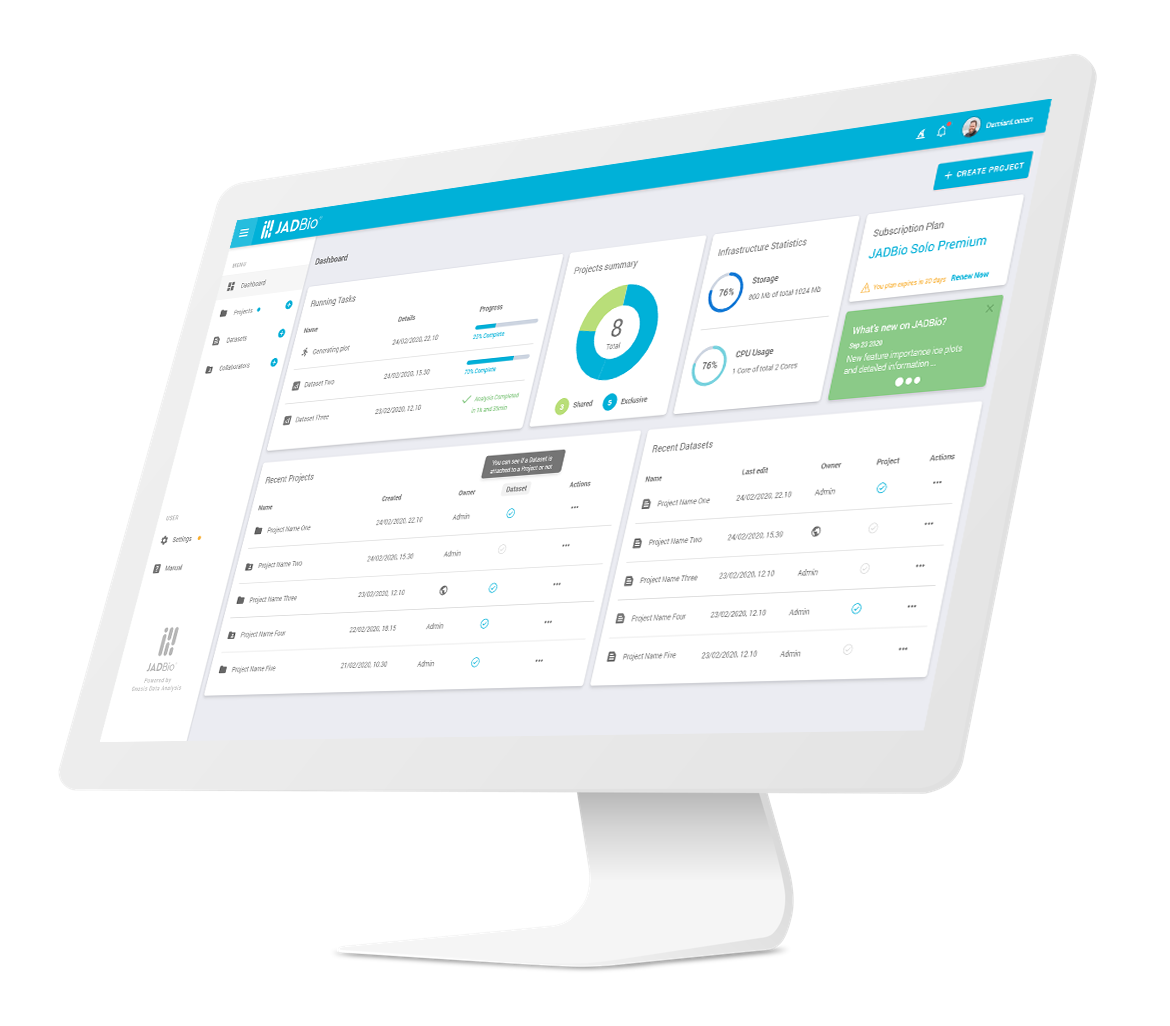

JADBio Automated Machine Learning Platform

Join us at the BioData World Congress 2-4 November 2021, Basel Congress Center, Basel, Switzerland, at the QIAGEN booth to learn more.

How Does it Work?

QIAGEN logo

You start by generating all your study data. That could either be data that has been processed and normalized by QIAGEN Bioinformaticians, or public data available in the OmicSoft Lands. You JUST upload that curated dataset to the JADBio app in a .csv or other delimited file format, select the desired predictive outcome, and watch the tool perform the analysis. Most analyses complete in a couple of hours.

Automated Machine Learning in 5 Steps

PREPARE THE DATA FOR ANALYSIS PERFORM PREDICTIVE ANALYSIS DISCOVER KNOWLEDGE INTERPRET THE RESULTS APPLY THE TRAINED MODEL

Click on icons for extended information

What Can I Predict with JADBio?

Disease Status (Diagnosis)

Disease Subtype

Response to Treatment

Phenotypic Trait

Time to Event (Death, Metastasis, Relapse)

Other discrete or continuous quantities

Works with All Types of Data

DNA

Metabolites

Clinical

RNA

Single Cell (any type)

Signals (EEGs, etc.)

Protein

Sequence Data (SNP, methylation, etc.)

Images

and any combination of the above…

What Do I Get as a Result?

1

Predictive models that could also be applied on new data

2

A set of most-relevant to your question predictive biomarkers (biosignatures)

3

Many visualizations to interpret results

4

Decision support information to apply model

JADBio identifies accurate predictive models that use as few biomarkers as possible.

JADBio BENEFITS

Achieves an unprecedented level of automation in performing AI-based analysis

Focuses on knowledge discovery applying novel feature selection algorithms

Keeps getting better with usage employing meta-level learning, i.e., ML on the ML results

Can also handle molecular data (low sample, high dimensional)

Simultaneously handles different data types (multi-omics, genetic, medical images, medical signals, etc.)

Correct and unbiased methodology

Bio-specific functionalities, featuring Survival analysis, bio-specific data preprocessing

Deep tech, Novel tech. Not just connecting existing black-box algorithms; developing new algorithms to solve open problems

SPEAK TO AN EXPERT